

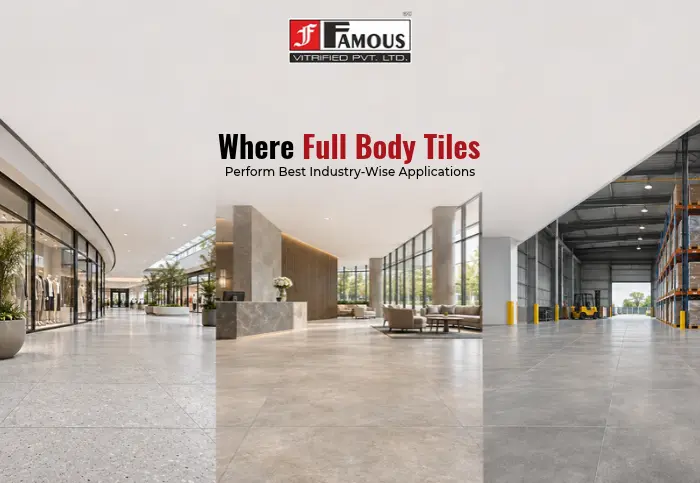
A shopping mall, a hospital and a manufacturing facility may have one thing in common: thousands of people moving across their floors.
But does that mean they need the same tiles?
Not quite.
A retail showroom cares about appearance. A hospital worries about cleaning and safe movement. A parking area deals with vehicle loads, dust and occasional oil spills.
Every industry puts flooring through a different test. That’s why Full Body Tiles are worth understanding beyond their strength and durability. Their real advantage comes from selecting the right specification for the right environment.
Full body tiles are commonly considered for high-traffic commercial and institutional spaces such as retail stores, hospitals, hotels, educational institutions and selected industrial areas. Their suitability depends on the application, surface finish, slip resistance, breaking strength, wear performance and installation conditions. The best choice is not necessarily the same across industries.
What Are Full Body Tiles?
Full body tiles are vitrified tiles in which the colour and material composition extend through the tile body. This construction can help make minor edge chips less visually noticeable compared with certain surface-decorated alternatives. They are available in different sizes, thicknesses and finishes for various flooring applications. However, full body construction alone does not determine slip resistance, load capacity or suitability for specialised environments.
Which Industries Benefit Most from Full Body Tiles?
Full Body Tiles have colour running through their body, helping minor chips appear less noticeable. Their low water absorption and durable construction also make suitable products worth considering for busy environments.
But where do they actually make the most sense?
| Industry | Common applications | Key selection factors |
| Retail | Showrooms, supermarkets, shopping complexes | Foot traffic, wear, cleaning and finish |
| Healthcare | Waiting areas, corridors, administrative spaces | Cleaning compatibility, slip resistance and joints |
| Hospitality | Lobbies, corridors, restaurants | Appearance, traffic, moisture and maintenance |
| Education | Classrooms, corridors, common areas | Wear performance, grip and ease of maintenance |
| Industrial | Selected workshops and utility areas | Loads, abrasion, impact and installation system |
1. Retail Stores: Where the Floor Is Always on Display
Retail floors have a difficult job.
They need to look attractive under bright showroom lighting while handling customers, shopping trolleys, display changes and daily cleaning. And when a store opens every morning, there’s little room for flooring repairs. Full Body Tiles can be a practical choice for supermarkets, showrooms and shopping complexes where regular foot traffic is expected.
For premium retail spaces, the right finish can complement the merchandise without distracting from it. But don’t choose a polished tile simply because it looks expensive. Consider entrance moisture, cleaning requirements and slip resistance too. A good retail floor should support the shopping experience, not become another attraction demanding maintenance.
2. Hospitals: Where Cleaning Is Part of the Daily Routine
Hospital flooring doesn’t get many quiet days.
Wheelchairs move through corridors. Medical trolleys travel between departments. Cleaning teams work repeatedly throughout the day. Here, appearance matters, but hygiene procedures and safe movement deserve greater attention.
Suitable Full Body Tiles can offer durable, low-water-absorption surfaces for selected hospital corridors, waiting areas and administrative spaces.
However, a hospital isn’t one uniform environment. Operating rooms and other specialised clinical areas may require flooring systems with additional properties. For general-use areas, buyers should examine cleaning compatibility, slip resistance, grout details and maintenance requirements. Because in healthcare, a beautiful floor is useful only when it works with the facility’s routine.
3. Hotels: One Property, Several Flooring Personalities
A hotel lobby wants to impress.
Its corridors need to handle luggage wheels, housekeeping trolleys and continuous guest movement. The restaurant has spills to consider. Outdoor areas face an entirely different set of conditions.
Would choosing one tile finish throughout the property really make sense?
Probably not.
Full Body Tiles can suit various hospitality spaces when their specifications match the application. A refined finish might work in a dry lobby, while textured options may be more appropriate in selected moisture-prone locations. For hotel developers, the smarter approach is choosing related colours across different finishes. The property maintains a consistent design language without forcing every space to behave like the lobby.
4. Educational Institutions: Built for the Everyday Rush
Schools and colleges don’t need flooring that looks perfect only on inauguration day.
They need something that can handle Monday morning.
Students rushing between classrooms, furniture movement, muddy shoes during monsoon and repeated cleaning all contribute to wear. Full Body Tiles can be considered for corridors, classrooms and common areas where suitable wear performance is important.
But stairs, washrooms and outdoor walkways require separate attention to grip and safety. A practical school floor should be easy to maintain, appropriate for daily traffic and selected with long-term upkeep in mind. Because replacing damaged flooring during an academic session is rarely convenient.
5. Industrial Buildings: Strength Needs a Specification
Factory flooring is where buyers need to be especially careful.
A light assembly area and a warehouse with heavy forklifts are not remotely the same.
Both are industrial spaces, but their loads, equipment and operating conditions differ.
Selected heavy-duty Full Body Tiles may suit workshops, utility corridors and other industrial areas when properly specified. However, specialised manufacturing environments may require flooring designed for chemical exposure, impact, vibration or concentrated machinery loads.
Before approving tiles, check breaking strength, abrasion resistance, substrate conditions and the proposed installation system. The word industrial alone is not a technical specification.
What Should Buyers Check Before Selecting Full Body Tiles for Commercial Projects?
| Specification | Why buyers should check it |
| Breaking strength | Helps assess performance under relevant loading conditions |
| Thickness | Must match product specifications and installation requirements |
| Abrasion and wear resistance | Important for repeated foot or wheeled traffic |
| Slip resistance | Relevant to wet areas, entrances and circulation spaces |
| Water absorption | Helps assess the tile's physical properties |
| Chemical and stain resistance | Relevant to cleaning and exposure conditions |
| Dimensional tolerances | Supports consistent installation and alignment |
| Substrate and installation system | Influences the performance of the completed floor |
Before placing a bulk order, request technical data for the exact tile collection, size and finish. A product suitable for a commercial lobby may not be suitable for a factory floor, parking area or specialised healthcare environment. The final specification should reflect both product performance and installation conditions.
Why Choose Famous Vitrified?
Famous Vitrified's product portfolio allows buyers to explore full body tiles across different finishes, designs, sizes and application-oriented categories. From commercial interiors to areas requiring specific surface traction or heavy-duty performance, product selection should begin with the project's technical requirements. Architects, contractors and bulk buyers can request relevant product specifications and samples before finalising their choices.
Buyers can compare finishes, sizes and technical specifications before selecting products for different industry requirements.
Let the Industry Decide the Floor
Durability isn’t simply about choosing a strong tile. It’s about choosing one that belongs there. Explore the Famous Vitrified catalogue for industry-specific collections, technical specifications and bulk project enquiries.
Frequently Asked Questions
Full body tiles are commonly considered for retail stores, hotels, educational institutions, commercial corridors and selected industrial areas. Their suitability depends on technical specifications and installation conditions.
Certain full body tiles can be suitable for high-traffic commercial flooring when their wear resistance, breaking strength, surface finish and installation system meet project requirements.
Suitable full body tiles may be considered for hospital waiting areas, administrative spaces and general corridors. Specialised clinical areas may require additional flooring properties or different systems.
Some products may suit selected industrial applications, but suitability depends on expected loads, abrasion, impact, chemical exposure and installation conditions. Not all full body tiles are appropriate for heavy industrial use.
Architects should assess traffic, moisture, cleaning requirements, surface traction, load conditions, appearance and relevant technical specifications before selecting tiles for a particular industry.
-
No Previous Blogs


