

At 8:30 in the morning, a hospital corridor is already busy.
Patients are moving between departments. Wheelchairs turn around corners. Cleaning teams have completed the first round. By afternoon, the same floor has handled thousands of footsteps, trolley wheels, spills and another cleaning cycle.
Now imagine closing that corridor because the flooring needs repair.
For a facility manager, that is the real flooring test.
Public buildings cannot be treated like spaces that remain untouched after handover. Hospitals, government offices, educational institutions, transport facilities and commercial public areas operate continuously. Their floors need to handle traffic while remaining practical to clean and maintain.
That is why project teams evaluating the best full body vitrified tiles in India increasingly look beyond appearance and consider what the floor will demand from the facility team five or ten years later.
Why Is Flooring a Facility-Management Decision in Public Buildings?
Architects specify the floor and contractors install it. Facility teams live with it. Every stain, damaged corner, slippery entrance or repair request eventually becomes an operational task. The right flooring should reduce those conversations, not create more of them.
Facility managers prefer Full Body Vitrified Tiles for public buildings because they offer better resistance to visible wear, easier maintenance, lower lifecycle repair requirements, and reliable performance in high-footfall areas such as hospitals, government offices, schools, airports, and transport terminals. Their homogeneous construction helps maintain a more uniform appearance even after years of heavy use and repeated cleaning.
How Do Full Body Vitrified Tiles Handle High Footfall?
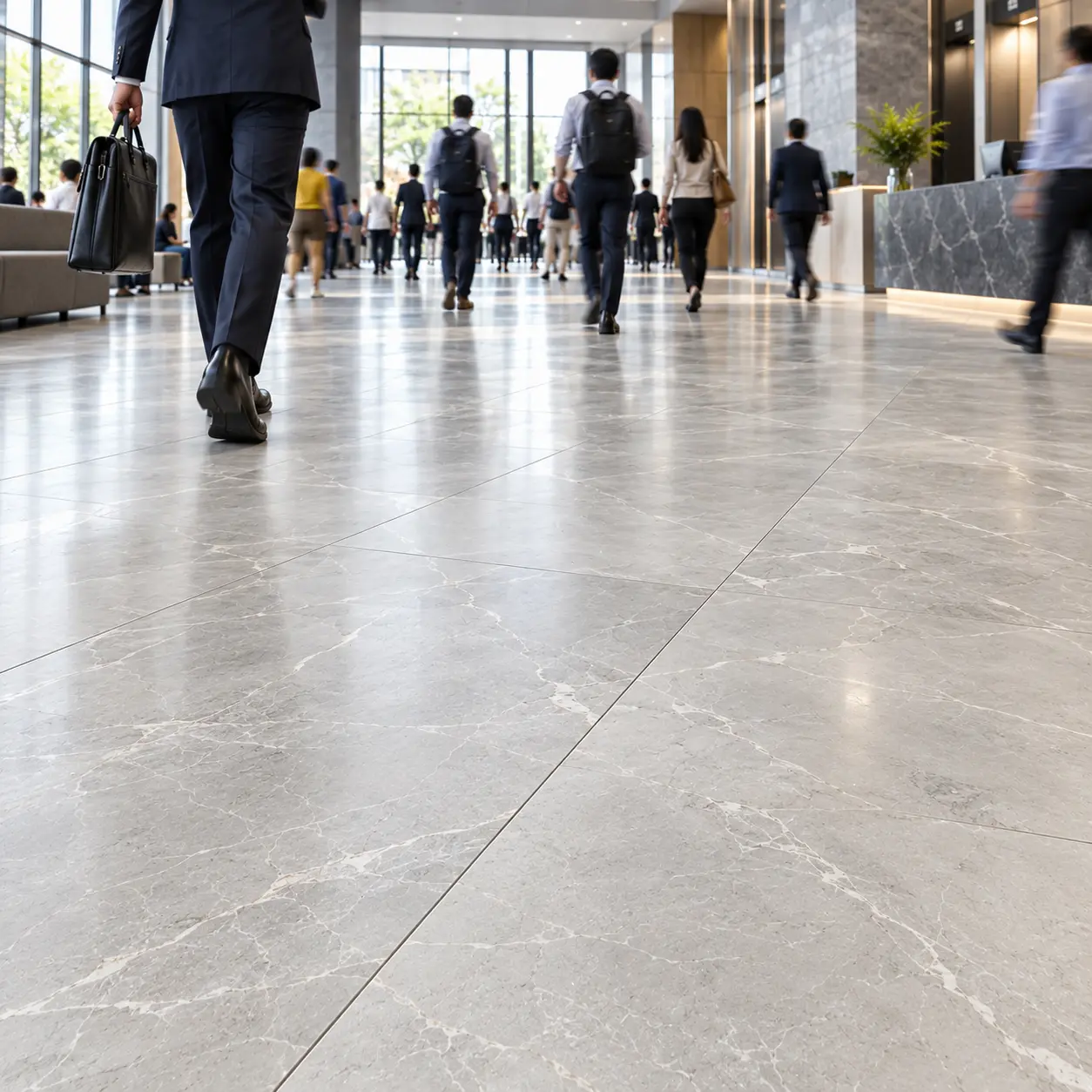
Public buildings rarely wear evenly. Look at the entrance to a government office. The centre receives far more traffic than the corners.
In hospitals, stretcher and trolley routes repeat throughout the day. In colleges, certain corridors become crowded between every class. At terminals, luggage follows the same pathways repeatedly.
This concentrated traffic is where surface wear becomes noticeable first.
Full body vitrified tiles have a homogeneous construction, meaning the colour and composition continue through the thickness rather than being limited to a decorative surface layer. That makes everyday chips and abrasion less visually obvious than they can be on contrasting surface-body products.
Why Is Lifecycle Cost More Important Than Tile Replacement Cost?
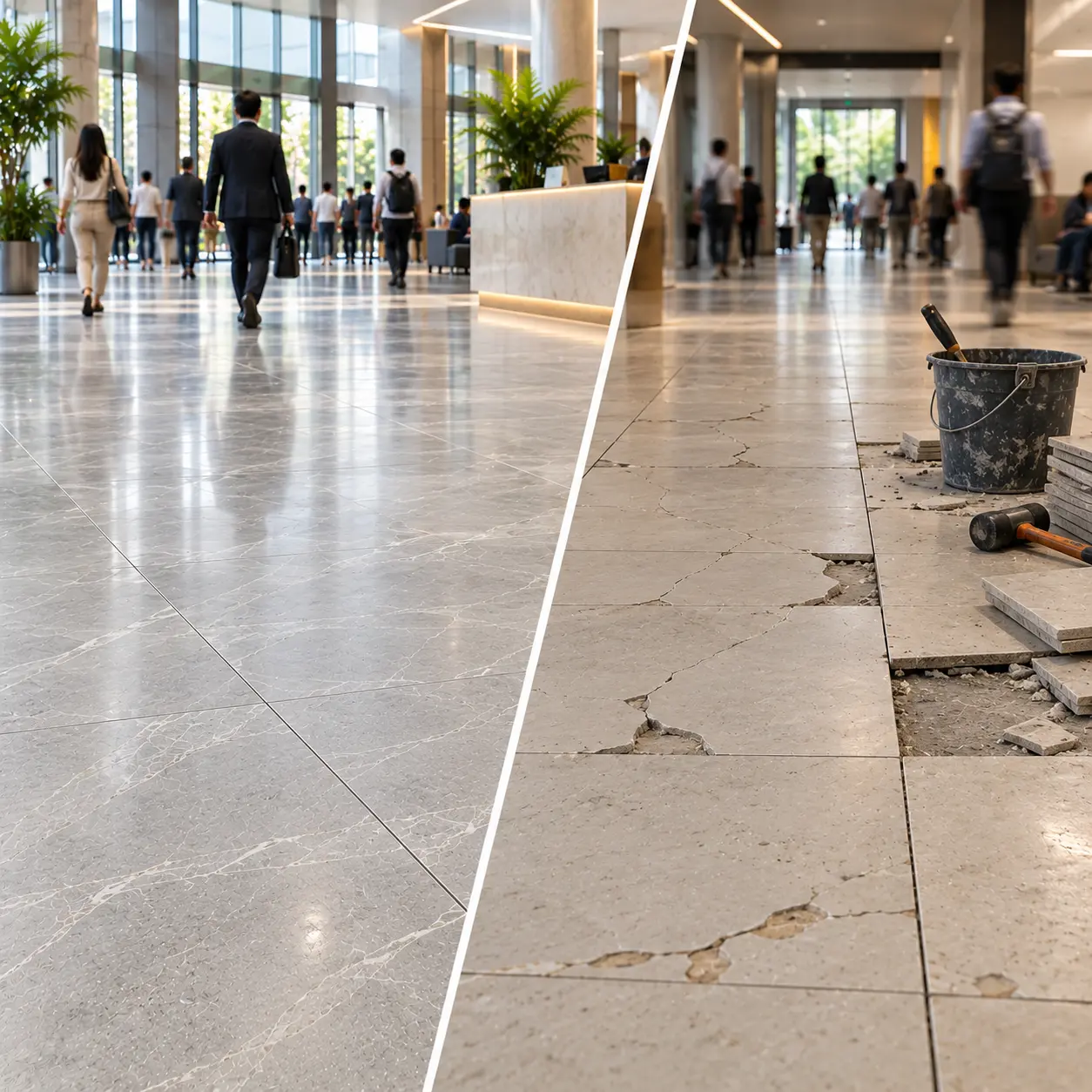
Suppose six damaged tiles need replacing in a busy public corridor. Six tiles do not sound expensive. But what else happens?
The area may need barricading. Pedestrian movement has to be diverted. Maintenance teams and contractors need access. Adhesive and grout need curing time. Furniture or equipment may have to move.
The material bill might be small. The operational interruption is not.
This is why facility managers tend to think in terms of lifecycle cost, not just purchase cost. A flooring system capable of resisting everyday wear can reduce the frequency with which occupied areas need intervention.
Full body vitrified should therefore be compared by expected application, mechanical performance and maintenance demands, not merely rate per square foot.
Should All Areas of a Public Building Use the Same Tile Finish?
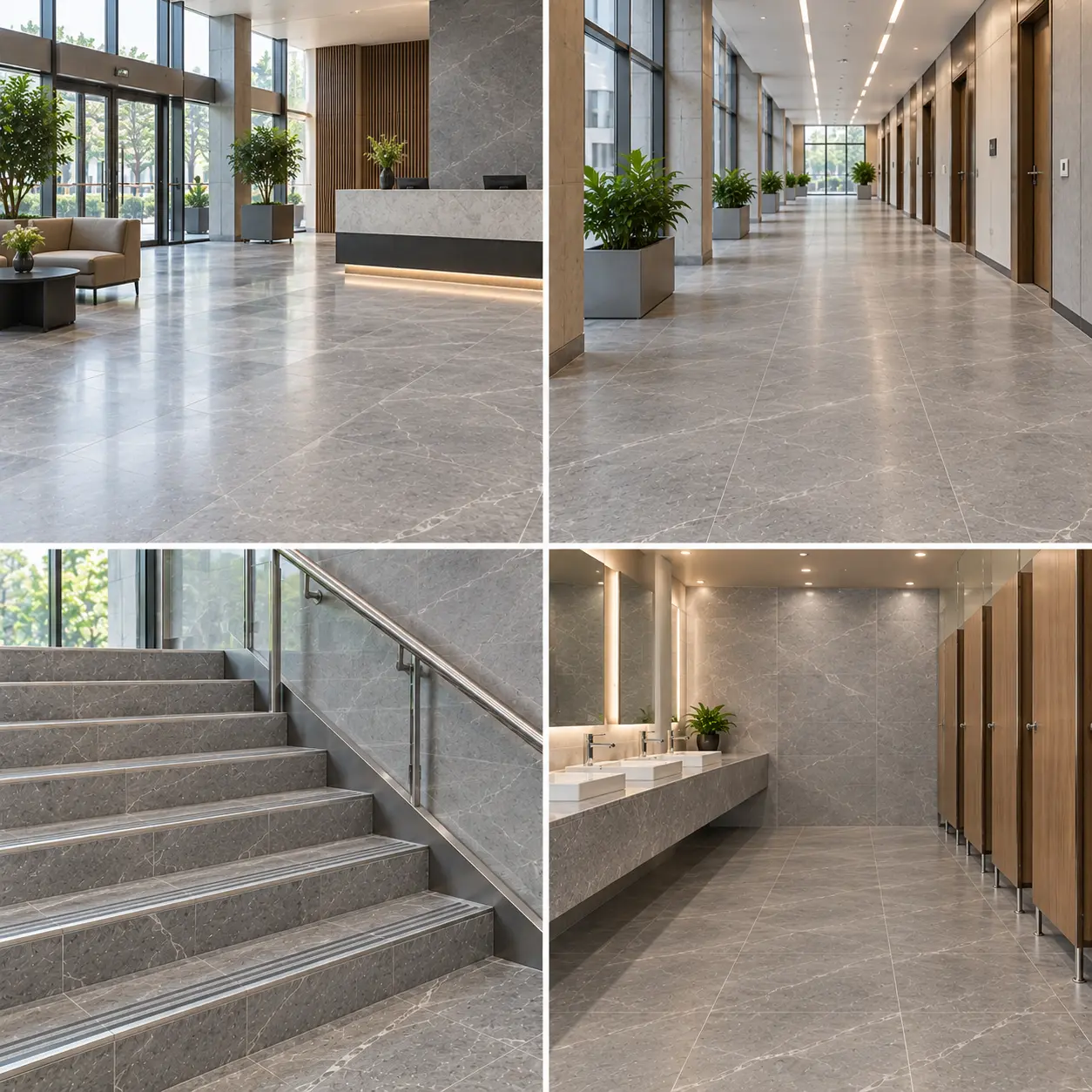
Durability is only one side of facility management. Safety and usability matter too. A polished-looking floor may suit an administrative lobby but require reconsideration near entrances, utility areas, ramps or spaces frequently exposed to water.
Famous offers anti-skid full body vitrified tile options in 600×600 mm and 600×1200 mm formats, with 9 mm and 15 mm thickness choices.
The important point is not to specify anti-skid surfaces everywhere. It is to zone the building properly.
Match flooring to the activity, expected moisture, traffic and maintenance routine of each area. Facility managers appreciate that approach because it solves practical problems before they become incident reports.
Can Full Body Vitrified Tiles Be Both Durable and Attractive?
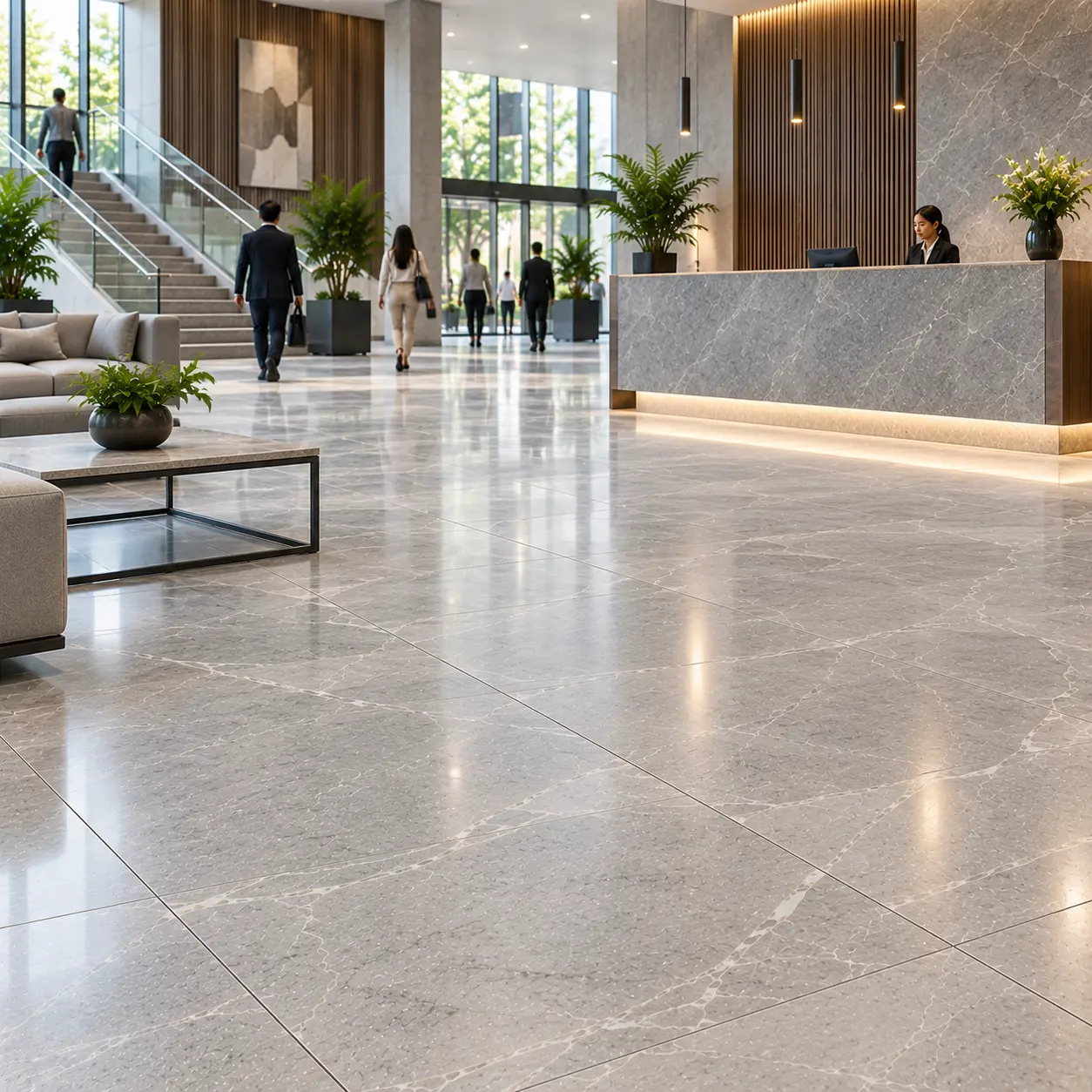
Durability does not give a floor permission to look industrial. Think about a new university campus or hospital. Visitors still form an impression from the entrance. Employees still work in the building every day.
The environment should feel considered.
Modern full body collections allow project teams to combine functional performance with different colours, textures, matt and glossy finishes. That gives designers flexibility while facility managers retain the practical benefits they need.
Quick Comparison: What Facility Managers Usually Evaluate
| Factor | Standard Decorative Flooring | Full Body Vitrified Tiles |
| High-footfall performance | Moderate | Better suited for heavy traffic |
| Visible wear over time | More noticeable | Less visually disruptive |
| Maintenance frequency | Higher | Lower |
| Repair-related disruption | More frequent | Reduced |
| Suitability for public buildings | Varies | Commonly preferred |
| Long-term appearance | May change faster | Better consistency |
Why Choose Famous Vitrified?
The best supplier for a public project is not simply the one with the largest catalogue. It is the one that can support the specification with clear performance data. Famous Vitrified publishes technical values for dimensional accuracy, water absorption, breaking strength, abrasion, chemical resistance and stain resistance based on recognised test methods.
For projects searching for the best full body vitrified tiles in India, Famous offers:
- Full body and anti-skid collections
- 600×600 mm and 600×1200 mm formats
- 9 mm and 15 mm options in anti-skid range
- Published technical performance specifications
- Solutions positioned for corridors, commercial floors, industrial areas and outdoor applications
A Good Public Floor Is the One Nobody Has to Talk About
No facility manager wants flooring to become a weekly agenda item. They want corridors open, cleaning predictable and maintenance teams focused on more important jobs.
Choose Famous Vitrified when your project needs flooring designed for life after handover, because in a public building, dependable performance is often the feature people notice least, and facility teams value most. Mail us at [email protected] to learn more about our products and pricing details.
Frequently Asked Questions
They are designed to handle high footfall, repeated cleaning, and everyday wear while maintaining a more consistent appearance over time.
Yes. They are commonly considered for hospital corridors because they offer durability, easy maintenance, and long-term performance in busy circulation areas.
Anti-skid surfaces provide better grip in entrances, ramps, utility areas, and other spaces where moisture or spills may increase the risk of slipping.
They generally require less frequent repair and replacement than many lighter-duty flooring options, which can help reduce maintenance effort in occupied public buildings.
Formats such as 600×600 mm and 600×1200 mm are widely used in commercial and institutional projects because they balance installation efficiency with visual appearance.
They are designed to handle high footfall, repeated cleaning, and everyday wear while maintaining a more consistent appearance over time.
Yes. They are commonly considered for hospital corridors because they offer durability, easy maintenance, and long-term performance in busy circulation areas.
Anti-skid surfaces provide better grip in entrances, ramps, utility areas, and other spaces where moisture or spills may increase the risk of slipping.
They generally require less frequent repair and replacement than many lighter-duty flooring options, which can help reduce maintenance effort in occupied public buildings.
Formats such as 600×600 mm and 600×1200 mm are widely used in commercial and institutional projects because they balance installation efficiency with visual appearance.
 Previous Blog


